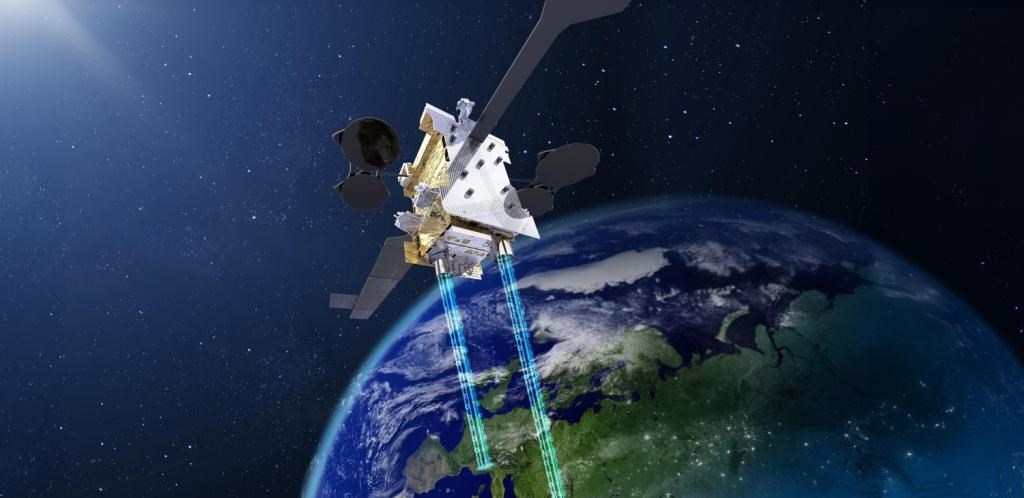
Operator Hellas Sat, the French Space Agency (CNES), Thales Alenia Space - a joint venture between Thales (67%) and Leonardo (33%) - and Safran have signed a framework cooperation agreement to develop a next-generation optical communications system to be hosted on the future Hellas Sat 5 geostationary telecommunications satellite and the associated Optical ground station to be deployed in Cyprus.
This partnership will deliver ultra-high-performance, very high-throughput data transfer services from geostationary orbit, enabling faster, more secure and more resilient satellite communications for critical applications. It is built on CNES’s SOLiS project1, led by Thales Alenia Space as part of the space component of the France 2030 program, and will demonstrate very high-data-rate laser communications services through the atmosphere.
Under this European cooperation, Thales Alenia Space will supply the SOLiS system and the onboard optical payload for the Hellas Sat 5 geostationary telecommunications satellite. Safran will provide a prototype commercial (“pilot”) ground station, which will be installed at Hellas Sat ’s teleport in Cyprus (CyOGS). This pilot station will communicate with CNES’s FROGS station already operating at the Côte d’Azur Observatory on the Mediterranean coast. This communications system will be designed to enable interoperability with other Satellite optical communications systems under development.

Market forecast by Region and Platform Type. Country Analysis, Market and Technology Overview including Critical Raw Materials, Opportunity Analysis, and Leading Company Profiles
Download free sample pages More informationPoised to revolutionize satellite telecommunications, free-space optical communications could become a new standard for secure, space-based data transmission, thanks to greatly enhanced capabilities that can deliver data rates on the order of a terabit per second — despite the distances involved and disruptions caused by atmospheric turbulences. It is designed to make intercontinental networks more resilient, as terrestrial and subsea optical fiber links are increasingly subject to sabotage. In this respect, geostationary telecommunications satellites are a proven solution: cost-effective and offering continuous coverage for massive, ultra-secure data transfers between users on the ground.
The cooperation agreement was signed during a special ceremony held at the Battlefield Redefined 2026 Conference (Nicosia, Cyprus), being an event co-organized with DG DEFIS of the European Commission οn the occasion of the Cypriot Presidency of the European Union. During this significant event, Greek and Cypriot ministers and representatives from Hellas Sat, CNES, Thales Alenia Space and Safran, as well as the National Observatory of Athens, the Hellenic Space Center (the Hellenic Space Agency) and a number of Cypriot and Greek ministerial bodies and governmental authorities as well as significant space stakeholders participated, thus emphasizing the European character and geopolitical symbolism of the said initiative.
Christodoulos Protopapas, CEO of Hellas Sat, said: “The cooperation with CNES, Thales Alenia Space and Safran is a strong endorsement of Hellas Sat as a resilient, credible and strategic European satellite operator. Working alongside leading European space institutions and industrial champions reinforces the trust, added value and international standing of Hellas Sat.
Next Generation optical satellite communications are of strategic importance for Greece and Cyprus, enhancing the resilience, security and sovereignty of critical national and governmental communications. Through the Hellas Sat 5 program, Hellas Sat actively contributes to the development of next-generation technologies that strengthen Europe’s secure connectivity and strategic autonomy.
This partnership, bringing together France, Greece and Cyprus, reflects the strong European spirit of cooperation and technological progress thus demonstrating how joint innovation can support long-term technological leadership at both national and European level.”
“The opportunity to fly and operate the SOLiS system in cooperation with Hellas Sat is a major step towards the adoption of free-space optics for very high throughput Ground-to-Space communications. The service demonstration carried out in the frame of the France 2030 program by Thales Alenia Space, Safran and their SOLiS partners is key to qualify first operational applications to be offered by this disruptive technology.” said Lionel Suchet, Deputy Chief Executive Officer f rom CNES.
“We’re delighted to work with Hellas Sat, CNES and Safran to develop this optical communications system — a key building block in the creation of a secure, very high-throughput data transmission network,” said Alcino de Sousa, Senior Vice President, Telecommunications at Thales Alenia Space. “This partnership marks the start of a new era for telecommunications services. By combining multiple wavelengths, the SOLiS system will deliver unmatched performance, approaching 1 terabit per second.”
“We are proud to take part in this European cooperation, which places innovation at the service of sovereignty and the security of strategic communications. Safran will contribute its recognized expertise in very high-speed optical links by providing the pilot ground station in Cyprus. This project perfectly illustrates our commitment to supporting European autonomy and delivering reliable solutions for the most critical applications in an ever-evolving environment”, said Jean-Marie Bétermier EVP Space for Safran Electronics & Defense.