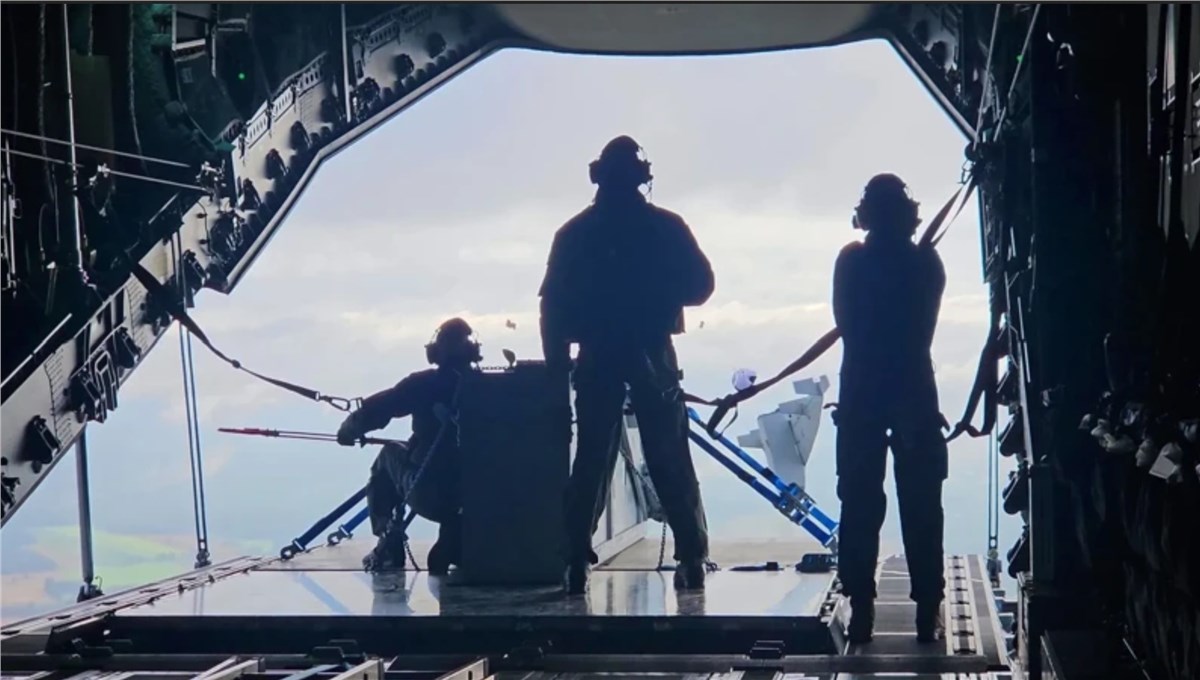
Last autumn, sensor specialist and solutions provider HENSOLDT successfully performed flight tests for the deployment of the HADIS unmanned carrier system from an A400M aircraft. HADIS is an unmanned, autonomous, disposable remote carrier that can be deployed from a transport aircraft and is designed as a cargo glider in its initial version. The system was conceptualized in 2024 as part of a self-financed innovation project and has already been successfully deployed from smaller transport aircraft. In the test campaign, which was supported by the German Armed Forces with the support of an A400M and accompanied by the Bundeswehr Technical Center for Aircraft and Aeronautical Equipment (WTD 61), the HENSOLDT team was able to impressively demonstrate the functionality of a scaled 1:3 version of HADIS. Both the deployment process using a parachute extraction method and autonomous waypoint navigation in gliding flight were successfully demonstrated.
This clears the way for the targeted further development of HADIS, so that a full-scale demonstrator can be provided as a cargo glider by the end of 2026. This should be capable of transporting loads weighing up to 500 kg up to 120 km after being dropped from a transport aircraft.
The cargo glider, consisting of wings and a fuselage, is designed as a disposable platform and is intended to safely supply special forces operating deep in enemy territory. The electronics required for control are housed entirely in the wings, while the fuselage serves as a cargo box for the material to be transported. In contrast to autonomous parachute glider systems, HADIS can be used to achieve significantly longer gliding flights, allowing the manned carrier aircraft to remain well outside the danger zone of the specific area of operation. The deployment concept envisages that several HADIS systems can be dropped from a transport container. These gliders can fly in a swarm formation to either a common or separate landing points.

Market forecast by Region, Mission Type, and Platform Type. Country Analysis, Market Overview, Technologies and Developments, and Leading Company Profiles
Download free sample pages More informationAfter opening the cargo ramp of a transport aircraft (e.g., A400M), the cargo glider is pulled out of the transport box in the cargo hold by a extraction chute and then enters the gliding phase. Navigation to the designated landing zone is either controlled by local forces on the ground or in the aircraft, or autonomously via waypoint navigation. Due to the precise parachute landing, it can take place anywhere.
In its initial version, HADIS has no propulsion system that causes noise or other emissions, making it significantly more difficult to detect.
With HADIS, HENSOLDT is underlining its outstanding capabilities as an innovation partner in the aviation sector and as a provider of complete solutions for multi-domain operations.

Amman, Jordan
Jun 30 - Jul 1, 2026