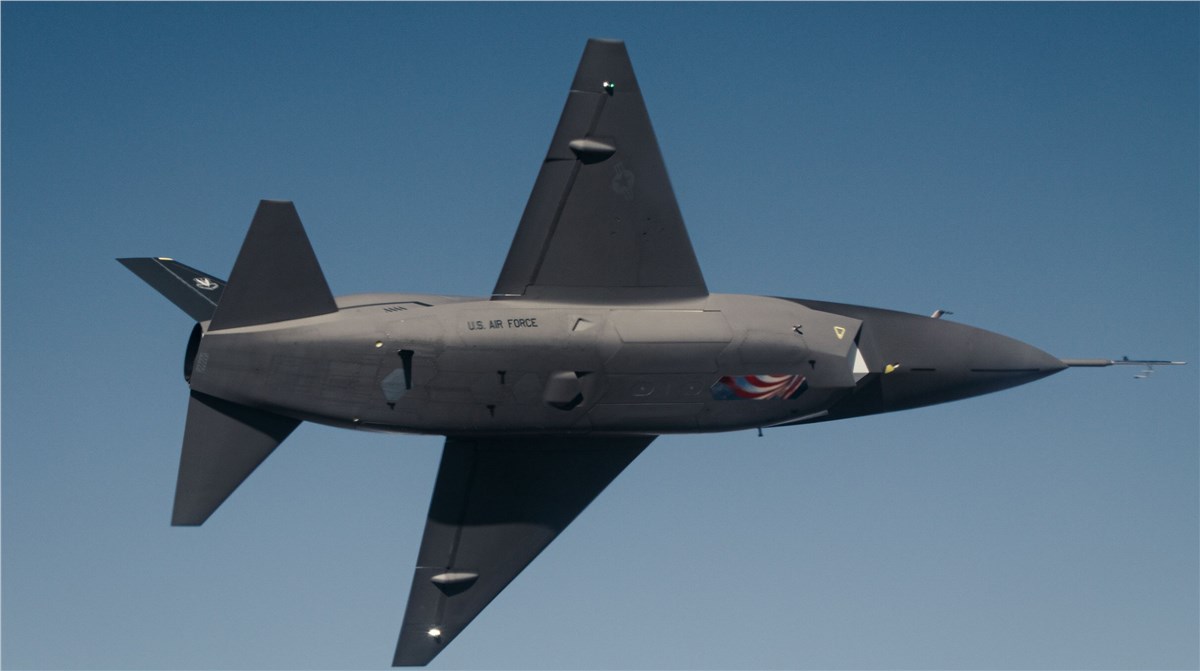
Just four months ago, the first flight of Anduril’s YFQ-44A marked the start of a new chapter in the history of aviation: the first semi-autonomous flight of a fighter-class Collaborative Combat Aircraft.
Today, Anduril achieved another milestone for the U.S. Air Force’s Collaborative Combat Aircraft program: YFQ-44A flew with two different mission autonomy software suites, made by two different vendors, on the same aircraft, on the same flight. The aircraft took off and autonomously approached a designated point where Shield AI’s mission autonomy software stack, Hivemind, was activated to complete a series of test cards. Following completion of Hivemind tests, Anduril was able to seamlessly switch to Anduril’s Lattice for Mission Autonomy stack to complete the same test points, before returning safely to land.
The flight test is the latest in a series of milestones that demonstrates the program’s rapid progress: Anduril was selected to produce CCA prototypes in April 2024, achieved semi-autonomous flight 556 days later, and now has multiple aircraft flying regularly. The integration of a separately-developed autonomy stack is a significant technical endeavor that was achieved in rapid time because of the early implementation of A-GRA on both the YFQ-44A and the mission autonomy software stack. The integration of mission autonomy software unlocks the next critical phase of testing, including detailed mission CONOPs, weapons integration, multi-ship flights, integration with crewed fighters, and more.
Market forecast by Region, Type, and Fitment. Technologies and Market Overview, Critical Raw Materials, Country Analysis, Opportunity Analysis, and Leading Companies
Download free sample pages More informationHivemind
For the past several months, Anduril’s YFQ-44A team has been working in close collaboration with the team at Shield AI to integrate their Hivemind mission autonomy software suite into our CCA aircraft. The similarities we share in our approaches to software development, commitment to speed, and technology maturity have streamlined our collaboration during a critical period focused on rapid testing, iteration, and improvement.
Engineers from Anduril and Shield AI have worked shoulder-to-shoulder to integrate Hivemind seamlessly with the flight control software on YFQ-44A, testing the combined system’s performance across countless software-in-the-loop simulations and milestone hardware-in-the-loop test events to build confidence in the stack’s performance in the lead-up to our first mission autonomy flight.
The result? During the flight test, Hivemind managed YFQ-44A through a complex series of test points that were representative of future mission CONOP. The software performed as expected, validating our shared approach to integration, development, and testing. We look forward to accelerating our work with the Shield AI team over the coming months.
Lattice for Mission Autonomy
The U.S. Air Force has designed the CCA program to emphasize constant competition, modularity, and the ongoing, rapid integration of best-of-breed hardware and software capabilities. That approach extends to mission autonomy software, where they have defined a universal Autonomy Government Reference Architecture (A-GRA) standard to foster a more competitive and innovative ecosystem of software suites.
Over the past year, Anduril has invested its own dollars and dedicated a team to aggressively build our Lattice for Mission Autonomy software baseline with a single goal: build the absolute best mission autonomy for air dominance product, period. That singular focus drove tireless execution across the team, because there is a belief that this capability must exist, and must exist at the highest of standards.
This flight with YFQ-44A marks a major milestone for Lattice for Mission Autonomy. We recognize that our work here is only just beginning and we are committed to building both the capability itself and warfighters’ trust in the system.
Modularity unlocks capability
YFQ-44A was designed from the ground up as a highly modular, flexible aircraft. With a simple design, external stores, and open hardware and software architectures, YFQ-44A can easily be configured with a range of mission systems, software suites, and payloads to support a variety of missions.
The integration of two mission autonomy software suites into a single YFQ-44A sortie serves as the latest evidence of that modularity. It also validates the program’s approach to acquisition: by emphasizing open hardware and software architectures, the CCA program has created a competitive ecosystem of software providers for the Air Force to draw upon as mission needs evolve.
Together, with our partners in the United States Air Force and in industry, we continue to take important steps into a new era of military aviation defined by mass, autonomy, affordability, flexibility, and speed. From starting production at Arsenal-1 to proving out YFQ-44A in increasingly complex mission sets, we are looking forward to what comes next.