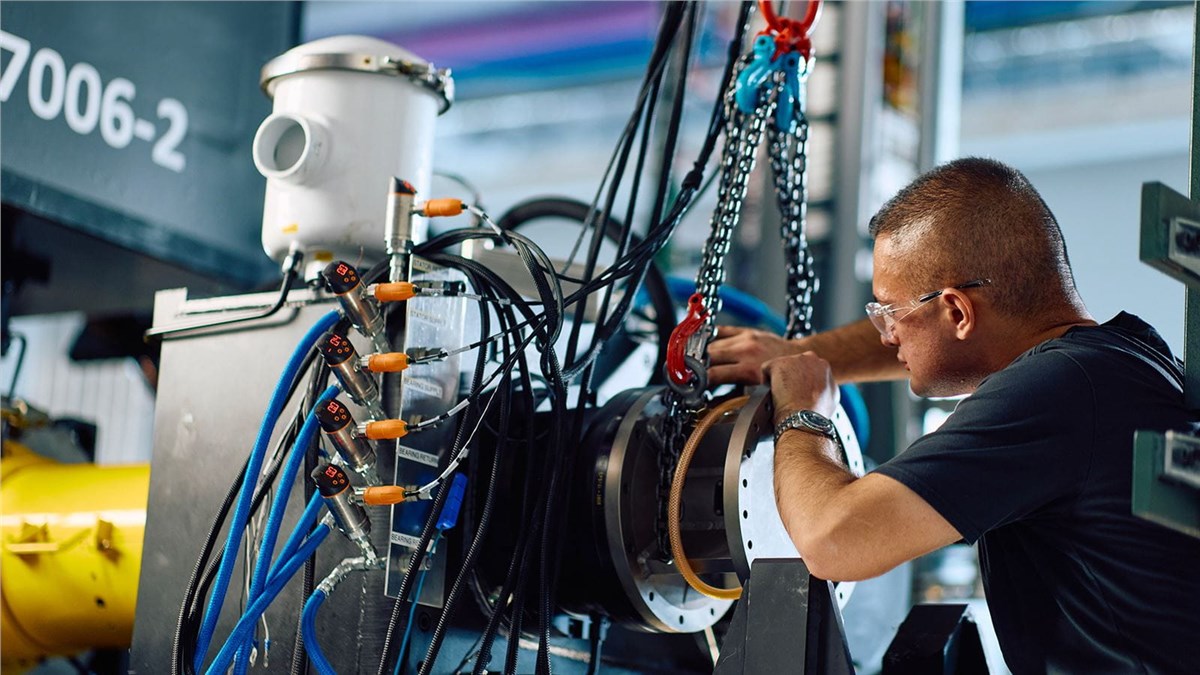
Collins Aerospace has begun initial testing of the electric motor drive systems for the European Union's Clean Aviation SWITCH project, a key step towards demonstrating the hybrid-electric technology on a full-scale Pratt & Whitney GTF™ engine. Integrated lab tests of the hybrid-electric powertrain subsystem, including motor generators, controllers and power distribution systems, are taking place at "The Grid," Collins' advanced electric power systems lab in Rockford, Illinois. Collins Aerospace and Pratt & Whitney are RTX (NYSE: RTX) businesses.
The SWITCH project is focused on demonstrating the potential of hybrid-electric technologies to optimize engine efficiency across different phases of flight for future short- and medium-range aircraft. Key subsystems validated at The Grid, including two megawatt-class motor generators, will be integrated within a hybrid-electric Pratt & Whitney GTF engine demonstrator as part of the next phase of testing.
"The start of powertrain subsystem testing is a key step towards demonstrating the potential of applying more electric systems to future commercial aircraft," said Kristin Smith, vice president, Electric Power Systems at Collins Aerospace. "Hybrid-electric technology has the potential to transform aviation by enabling greater fuel efficiency across multiple future platforms, including next generation single-aisle aircraft."

The SWITCH powertrain incorporates multiple key components developed at world-class research and development facilities across Europe. Collins Aerospace designed and produced megawatt-class electric motor and controllers at its Solihull, UK facility, while power distribution components including a solid-state power controller and power distribution panel were designed in Nördlingen, Germany. The high voltage electrical wiring interconnection system developed by GKN Aerospace was built in Papendrecht, Netherlands.
SWITCH is a collaborative effort involving MTU Aero Engines AG, Pratt & Whitney, Collins Aerospace, GKN Aerospace, Airbus and several European research institutions. Collins Aerospace is also engaged in multiple ongoing Clean Aviation projects targeted at enabling hybrid-electric propulsion and more electric aircraft architectures across regional and short- and medium- range platforms.
Funded by the European Union under GA no. 101102006 — SWITCH. Views and opinions expressed are, however, those of the author(s) only and do not necessarily reflect those of the European Union or Clean Aviation. Neither the European Union nor the granting authority can be held responsible for them.

National Harbor, MD
May 27 - 28, 2026