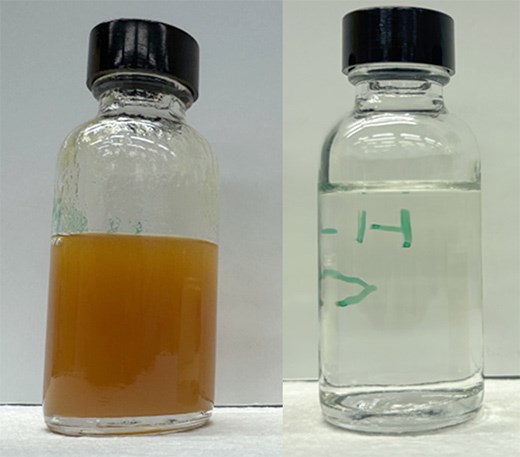
IHI has successfully synthesized Sustainable Aviation Fuel (SAF) from CO2 and hydrogen in its ongoing efforts to develop a novel SAF technology pathway. The synthesized sample demonstrated favorable properties as SAF in an evaluation at Washington State University, a globally recognized authority on aviation fuel assessment.
Since 2022, IHI has collaborated with the Institute of Sustainability for Chemicals, Energy and Environment (ISCE²), a research institute under Singapore’s Agency for Science, Technology and Research (A*STAR), to develop a technology which directly synthesizes SAF precursor hydrocarbons from CO2 and hydrogen. Laboratory tests to date have confirmed world-class catalytic performance.
In September 2025, IHI began trial of liquid hydrocarbons synthesis from CO2 and hydrogen in IHI’s test unit in ISCE2 campus. IHI has explored its potential by upgrading the liquid hydrocarbons to jet fuel-range products. The sample properties were evaluated at Washington State University, a renowned institution recognized by ASTM International for prescreening, testing, and evaluation of alternative aviation fuels. The results confirmed that IHI’s sample exhibited excellent fuel properties.
Market forecast by Region, Pathway, and Platform. Country Analysis, Market and Technology Overview including Supply Chains, Opportunities and Scenario Analysis, and Leading Company Profiles
Download free sample pages More information“IHI’s new candidate jet fuel sample met or exceeded all the testing characteristics we look for in early SAF candidates,” said Dr. Joshua Heyne, Director of the Bioproducts, Sciences, and Engineering Laboratory at Washington State University. “Specifically, hydrocarbon composition and cold flow properties such as viscosity were all favorable.”
The results represent an important first step toward ASTM qualification for the commercialization of this novel synthesis method, which directly converts CO2 and hydrogen into hydrocarbons.
The International Civil Aviation Organization (ICAO) has set a long-term goal to achieve net-zero CO2 emissions from aircraft by 2050, and it is expected that much of the petroleum-based aviation fuels will be replaced by SAF.
IHI aims to advance the development of efficient and stable SAF production technologies for the early establishment of economically viable and environmentally friendly carbon-neutral aviation.
Amsterdam, Netherlands
Jun 23 - 24, 2026