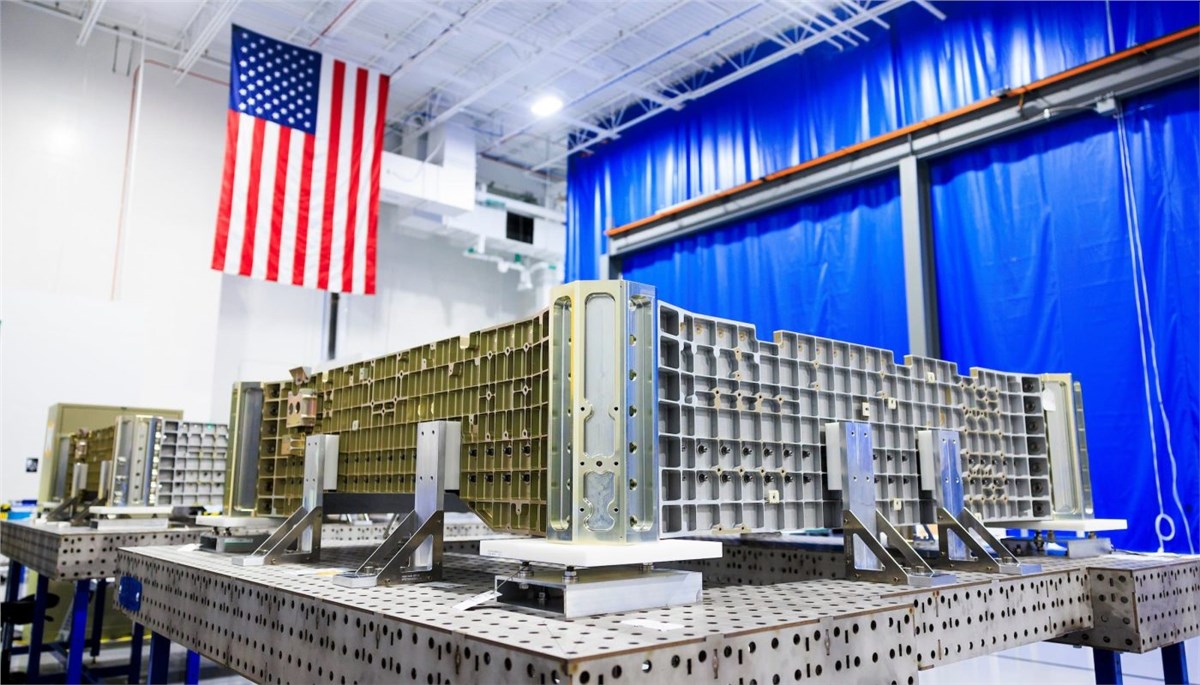
Sierra Space, a proven defense-tech company delivering solutions for the nation’s most critical missions and advancing the future of security in space, announced today the completion of the first nine satellite structures, Plane 1 of the 18 total satellites Sierra Space is contracted to deliver for the Space Development Agency’s (SDA) Tranche 2 Tracking Layer (T2TRK) program. Achieved three months ahead of schedule, this milestone underscores Sierra Space’s ability to meet key program milestones with efficiency and precision, helping to ensure that the T2TRK program remains on track for delivery and launch readiness.
“We stood up our high-rate manufacturing facility, Victory Works, to meet the demanding requirements of our customer,” said Erik Daehler, Senior Vice President of Sierra Space Defense. “To go from a successful Critical Design Review to completing the Plane 1 satellite structures—three months ahead of schedule—is a powerful validation of our investment in scalable infrastructure. Our team is energized as we move into the next phase of Plane 1 development, focusing on assembly, integration, and testing, while also beginning the satellite structure build for Plane 2, the remaining nine satellites of the 18-satellite constellation for SDA.”
The next stage currently planned for Plane 1 is a transition to the assembly, integration, and testing (AI&T) phase, during which components, subsystems, and payloads are expected to be integrated and subjected to rigorous testing to verify performance and readiness for deployment.

Market forecast by Region, Type, Application, and End-User. Country Analysis, Market and Technology Overview including Critical Raw Materials, Opportunity Analysis, and Leading Company Profiles
Download free sample pages More information“As we move closer to delivering this capability, every phase of development is essential to ensuring mission success,” added Daehler. “We believe the Tranche 2 Tracking Layer will provide unmatched missile tracking capabilities for SDA and its mission partners, and we remain committed to meeting each milestone with precision and speed.”
Building on this momentum, Sierra Space is also preparing to expand its capabilities to meet future demands for advanced fire-control and missile defense tracking systems.
“This mission is too important to not be continuously evolving,” said John Wagner, Sierra Space Vice President of Strategy and Business Development. “We are scaling our production capabilities and advancing our detection technologies, including the next generation of fire-control missile defense sensors. We believe our infrastructure, expertise, and track record position us to support the Department of War’s evolving needs for advanced tracking and missile defense.”
Sierra Space is contracted to deliver two orbital planes of satellites—18 in total—equipped with advanced infrared sensors to detect and track ballistic, hypersonic, and next-generation missile threats.
Sierra Space’s progress highlights its ability to combine commercial agility with deep defense expertise, delivering advanced solutions that meet the Department of War’s priorities. With over 30 years of spaceflight heritage and a track record of supporting more than 500 missions, Sierra Space continues to lead the way in building resilient mission systems for national security and allied partners.
About Tranche 2
The Tranche 2 Tracking Layer’s 54 satellites will build upon the Tranche 1 Tracking Layer capabilities with a select number of satellite vehicles that will incorporate fire control missile defense infrared sensors that can generate fire control quality tracks to provide preliminary missile defense mission capabilities in support of warfighter missions around the globe.
The Tracking Layer is focused on delivering a global constellation of infrared missile warning and missile tracking satellites that integrate with the Transport Layer’s low-latency meshed communication network, enabling advanced missile tracking from proliferated low-Earth orbit. Once completely fielded, the Tranche 2 constellation will consist of approximately 270 operational Transport and Tracking Layer satellites.

London, United Kingdom
May 5 - 7, 2026