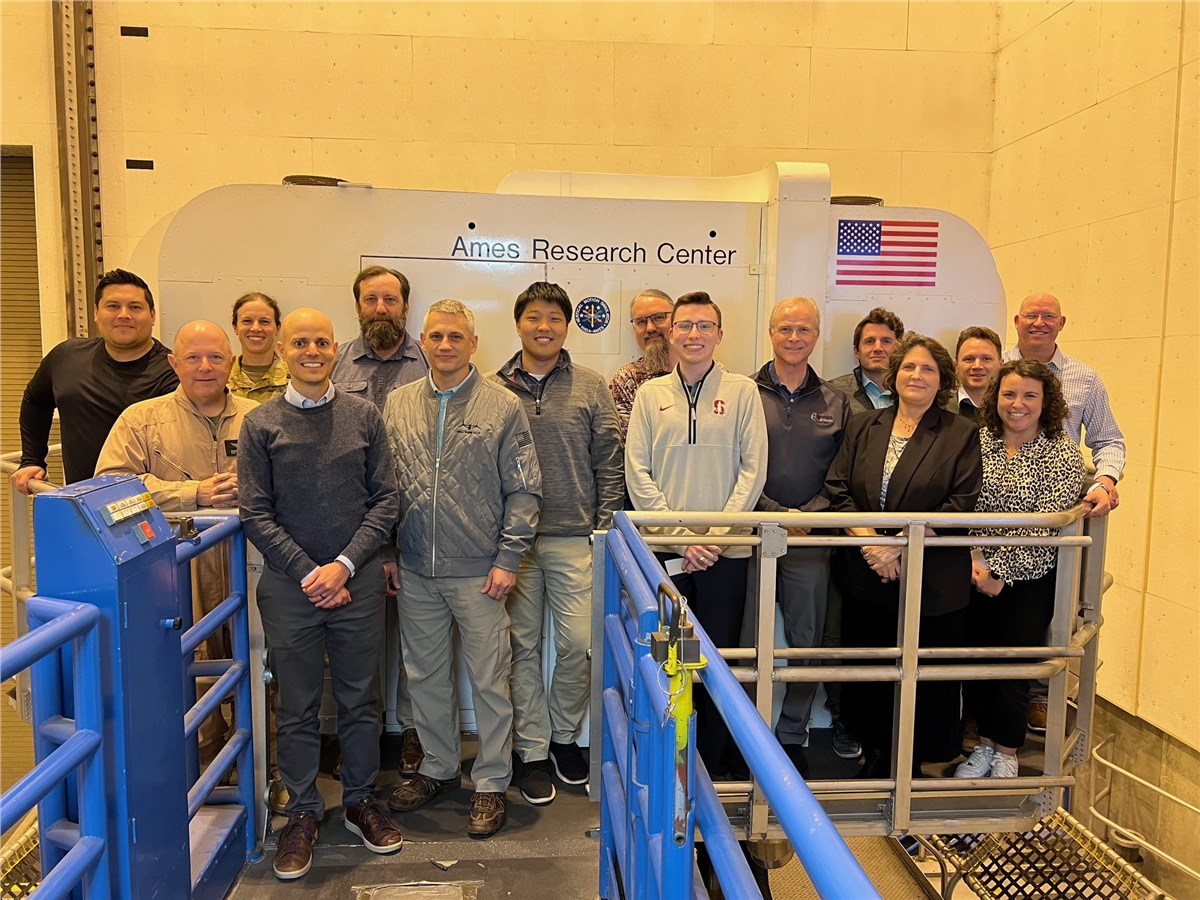
Bell and the U.S. Army are forging ahead with the MV-75 Future Long Range Assault Aircraft (FLRAA) and leveraging critical partnerships that enable the advancement of the program. Engineers and test pilots from the Army and Bell MV-75 FLRAA team recently collaborated with NASA to conduct key testing on the aircraft’s Level 1 handling qualities using the Vertical Motion Simulator (VMS) at the NASA Ames Simulation Lab.
To determine if the MV-75 FLRAA meets Level 1 handling qualities, the joint team evaluated its performance on the Mission Task Elements (MTEs) set by the Army. MTEs are the specific flight maneuvers that pilots fly to qualitatively assess an aircraft’s handling qualities. Validating Bell’s ability to meet the MV-75 FLRAA’s MTE handling qualities requirements is an important element of the Critical Design Review (CDR). Conducting these tests during the development stage is important in identifying any areas for improvement and reducing the design cycle for the aircraft.
NASA’s VMS is the largest flight simulator in the world, and it offers a high range of motion in all six ways an aircraft moves, including translational and rotational degrees of freedom. Work by digital display designers on the human machine interface (HMI) also allows the simulator to exercise methods to improve pilot awareness in degraded visual environments. The VMS’ ability to fully depict the ways an aircraft flies makes it the ideal platform to evaluate the MV-75 FLRAA’s MTEs.

Market forecasts by Region, Component, Simulator, Type, Service, Software, Hardware, and by End-User. Market and Technology Overview, Market Dynamics, Impact and Opportunity Analysis, and Leading Companies
Download free sample pages More informationThe Army is leading the work to inform future handling qualities requirements as part of its Advanced Rotorcraft Configuration Test of Increased Capability (ARCTIC) effort. As the Army’s partner in delivering MV-75 FLRAA, Bell and the Army have been working closely to develop the aircraft’s flight controls and coordinate with NASA to test them in their VMS.
This evaluation marked the first integration of the MV-75 FLRAA’s flight dynamics model and flight control laws into the VMS, providing a realistic depiction of how the actual aircraft will fly. It was a joint effort leveraging experts from Bell, the Army, and NASA across several disciplines including flight test pilots and engineers, human factors engineers, control laws engineers, handling qualities engineers, simulation engineers, and more. As the Army accelerates the program, work performed by this integrated team is critical to prepare for the first flight.
The evaluation resulted in positive feedback on the MV-75 FLRAA’s level 1 handling qualities, paving the way for future flight test activities. Moving forward, the VMS will remain a valuable asset to test flight control software updates before placing them in the aircraft.
The MV-75 FLRAA is a revolutionary capability for the Army with the ability to fly twice as far and twice as fast as the current fleet. By leveraging the expertise of the Army and NASA, Bell is safely developing and testing the aircraft to ensure that it meets our warfighters’ needs.