
Recently, a remarkable incident made the news: thousands of Airbus aircraft worldwide were grounded after cosmic radiation disrupted digital electronic systems. A problem long familiar in space applications is becoming increasingly relevant for aviation. Ongoing digitalisation is making modern systems more vulnerable to invisible radiation from space.
An unusual aviation incident captured global attention in late November. It resulted in thousands of Airbus aircraft being grounded after it emerged that cosmic radiation – high-energy particles from space – had disrupted digital avionics systems in late October. Now, the aircraft are back in operation after software updates that mitigate the problem. Nevertheless, the incident highlights a broader trend: as (aircraft) electronics become more advanced and compact, their sensitivity to cosmic radiation increases.
An invisible threat
“Cosmic radiation is invisible and always present,” Jasper Dijks, avionics systems researcher at NLR, explains. “At cruising altitude, aircraft are struck by millions of these particles every second. A single particle with sufficient energy can be enough to disrupt a flight computer – with potentially serious consequences.”
The phenomenon is not new to aviation, but it is relatively rare. Older aircraft with analogue systems and larger, more robust chips are generally less susceptible to radiation. In contrast, modern cockpits with more digital technologies rely on ever smaller transistors, making them more vulnerable, as less energy is required to cause a malfunction.
Satellites have been dealing with this issue for decades. Outside the protection of the atmosphere, cosmic radiation is so intense that unprotected satellites could become unusable within hours. For this reason, space computers are typically equipped with radiation-hardened chips, error-correcting codes and redundant systems.
What is cosmic radiation?
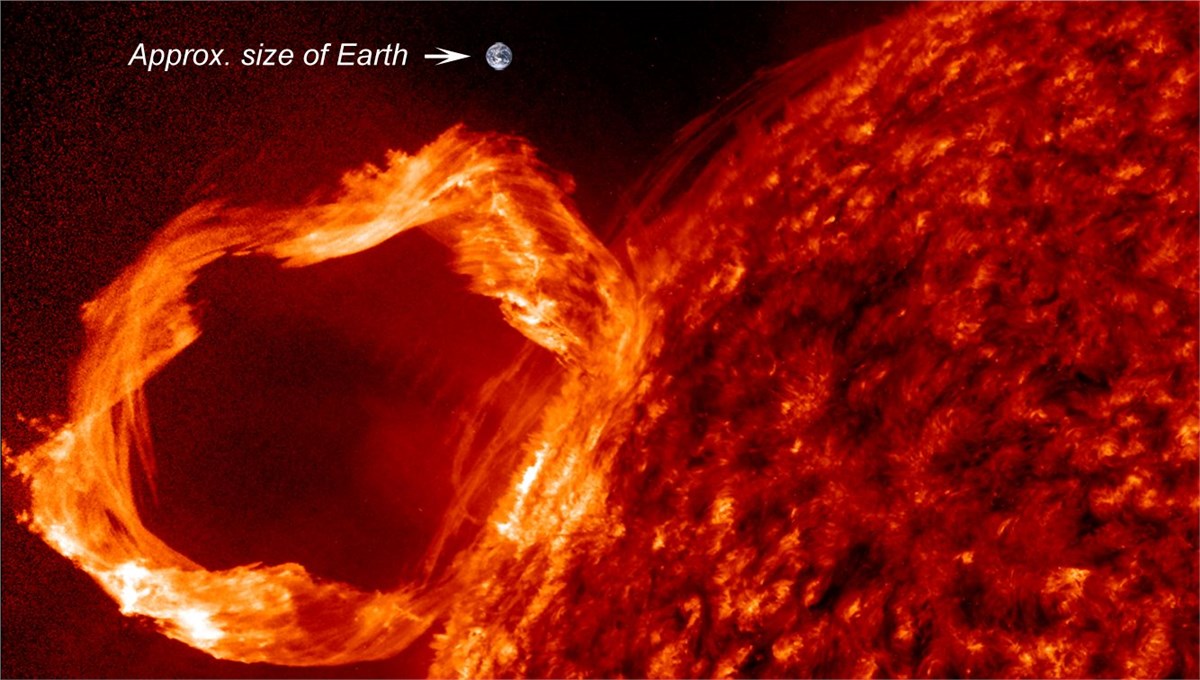
Cosmic radiation consists of high-energy particles (mainly electrons, protons and ions) from space that travel through the universe at nearly the speed of light. They originate from solar flares or stellar explosions.
On Earth we are protected by the planet’s magnetic field and atmosphere, but at cruising altitude (around 10 km) radiation intensity is already forty times higher than at sea level. A flight from Amsterdam to New York exposes pilots and passengers to roughly the same amount of radiation as a chest X-ray.
For electronics, the risk is different and statistically more significant: a single particle with sufficient energy, striking the wrong spot, could temporarily or permanently damage electronics with unpredictable consequences.
Predict and prevent
Addressing this problem requires two things. First, up-to-date knowledge of space weather conditions: solar activity, cosmic radiation peaks and geomagnetic storms. Organisations such as the National Oceanic and Atmospheric Administration (NOAA) in the USA and the European Space Agency (ESA) continuously monitor this activity and issue warnings when radiation levels are elevated.
What makes the Airbus incident particularly notable is that it occurred without major solar flares or extreme events. “This suggests that even normal background radiation or focused particle streams from solar activity can cause problems in sensitive modern electronics,” Dijks says. “That makes prediction all the more important, but also very hard.”
The second piece of the puzzle is even more complex: how sensitive are specific chips and systems exactly? “The only reliable way to determine that is through testing,” Dijks states. “Preferably under realistic and representative radiation conditions.”
A growing problem for critical systems
The issue becomes more relevant as technology evolves. The most advanced chips have transistors only a few nanometres in size – almost ten thousand times smaller than the width of a human hair. The smaller the transistor, the less energy is generally needed to disrupt it. This applies to virtually all electronics on Earth. Data centres deploying ever more powerful chips, for example, are also becoming more susceptible to these effects.
By better understanding when the risk is high and which systems are most vulnerable, system users – or the devices themselves – can act proactively: postponing critical operations during radiation peaks, activating redundant systems, or adjusting flight routes and altitudes. “The technology that enables us to do so much is at the same time becoming increasingly sensitive,” Dijks concludes. “That is why it is essential that we learn to properly understand these effects, predict them and protect ourselves against them – on Earth and beyond.”